
Custom heat exchangers, thermal energy storage and buffer vessels, ASME pressure vessels, and process equipment for mission-critical data center cooling infrastructure.
AI training and high-density computing have pushed rack loads far past what air alone can carry, and the heat now leaves the building through liquid. That moves the problem into the facility: pumps, exchangers, storage and heat rejection running continuously, under loads that change faster than the plant that serves them.
Equipment on that side of the system may operate continuously, manage changing thermal loads, and be designed around long-term serviceability and future capacity requirements. Harris Thermal fabricates the heat exchangers, vessels and tanks that live inside that infrastructure — designed to your process conditions, built to code, and tested before they ship.
Liquid-cooled hardware runs on its own circuit, the technology cooling system. A coolant distribution unit separates that circuit from the building's facility water system so each loop keeps its own chemistry, pressure and temperature. Heat then travels out through the facility water system to the plant that rejects it. Harris-fabricated heat exchangers, vessels and tanks apply on the facility side of that boundary. Coolant distribution units, cold plates, chillers, cooling towers, dry coolers, pumps, valves and controls are supplied by others, and Harris equipment is fabricated to interface with them.
Harris-fabricated equipment applies at the facility water stage and its interfaces.
Explore how heat exchangers fit into AI data center cooling infrastructure, including the relationship between coolant distribution units and facility water systems, plate versus shell-and-tube selection, cooling-water chemistry, material selection and reliability considerations.
Three groups cover what a cooling plant needs from a custom fabricator. Anything outside them is usually handled as custom fabricated process equipment.
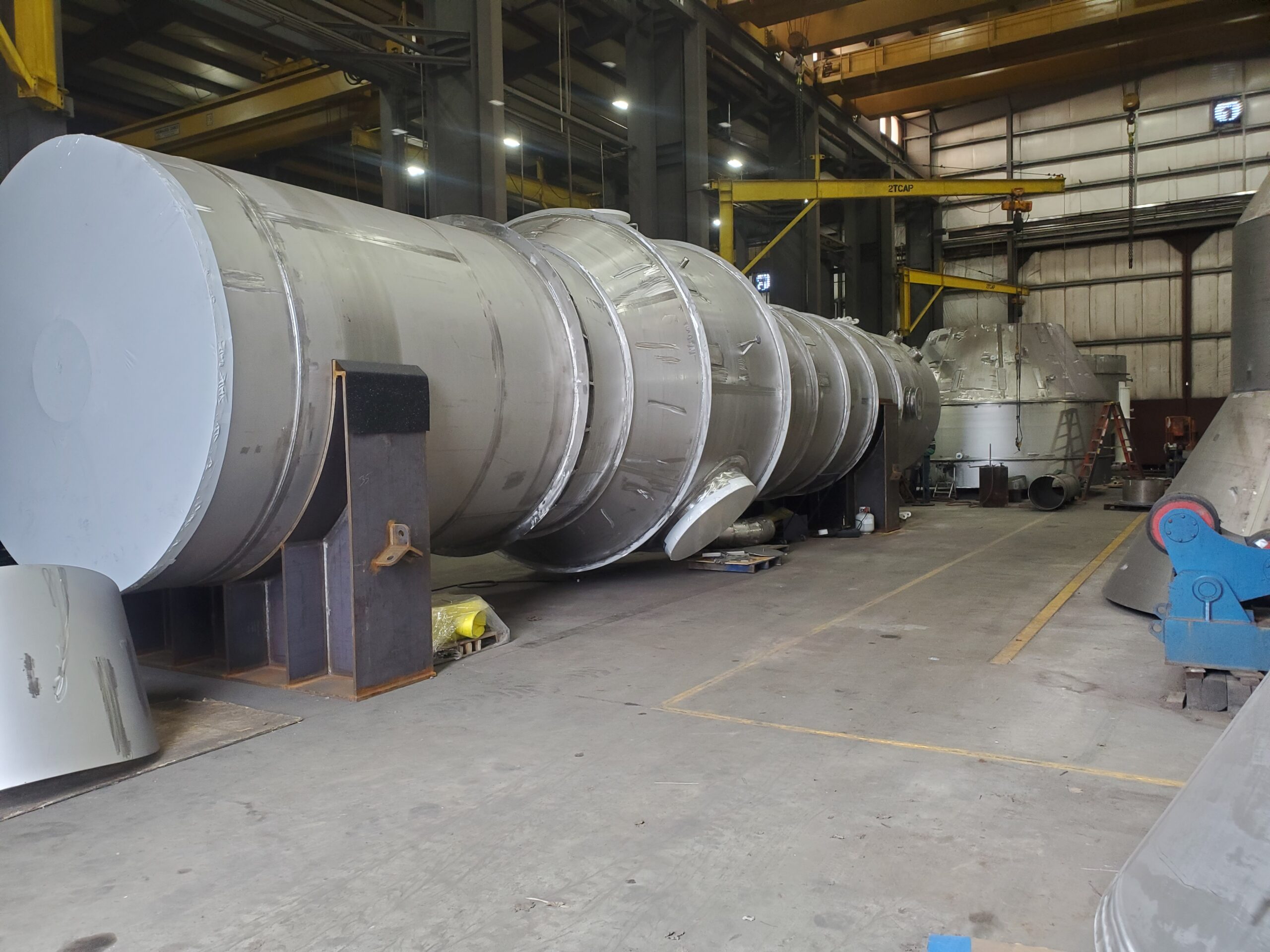
Thermal energy storage and buffer vessels add water volume and thermal mass to facility cooling systems, helping manage changing loads and operating transitions.
Heat transfer is what Harris Thermal has built for more than 140 years, and the facility side of a cooling plant is where custom exchangers earn their place. Our technical article works through what decides plate versus shell-and-tube selection.
Designed around project-specific process conditions rather than selected from a catalog, with in-house thermal and mechanical engineering — so process conditions are enough to start.
Built to existing geometry, nozzles and system constraints where a unit has to drop into a running plant, or re-rated for a duty above the original basis.
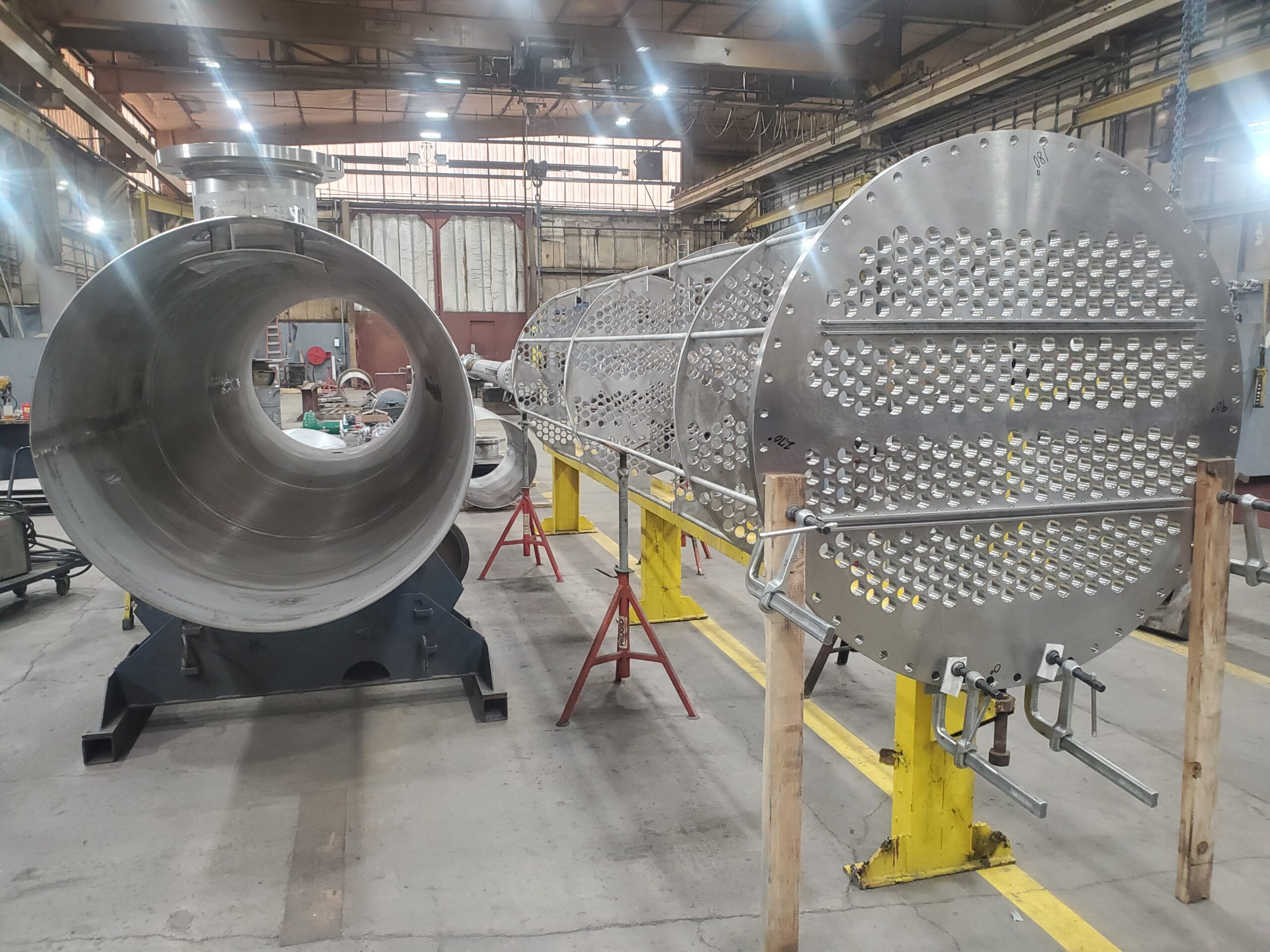
Where shell-and-tube suits the duty, access, cleanability and removable bundles decide whether a unit can actually be serviced in a crowded plant room across its life.
Reliability in fabricated equipment is not a promise, it is a process. Every unit is designed to project-specific conditions, built in our own shop rather than subcontracted out, examined and documented to the standard your specification sets, and dimensionally controlled so it fits the system waiting for it. Materials follow the service — carbon steel, stainless, duplex and titanium where conditions warrant it, from our full materials and metallurgy range.
Our quality control and inspection program and current certifications set out what we hold and how equipment is examined, tested and documented before it leaves the floor.
The fastest quote comes from a description of the duty, not a model number. If the duty is not fully defined, process conditions are enough for our engineers to work from. Dimensional and access constraints are worth raising early, because shipment planning often sets the equipment envelope.
Send what you have and our engineers will work through the rest with you — request a quote for custom cooling equipment.
Custom shell-and-tube heat exchangers, thermal energy storage and buffer vessels, ASME Section VIII, Division 1 pressure vessels and tanks, water-treatment and process vessels, and replacement or retrofit exchangers for existing plants — all on the facility side of a cooling system. Harris Thermal does not supply coolant distribution units, cold plates, rear-door heat exchangers, chillers, cooling towers, dry coolers, pumps, valves, instrumentation or controls, and does not perform field erection. Those are supplied by others, and Harris-fabricated equipment is designed to interface with them.
Both add volume and thermal mass to a chilled-water or condenser-water loop. A buffer vessel is normally sized to steady plant control and absorb short transients so equipment is not short-cycling. A thermal energy storage vessel holds a larger cooled volume, which a plant design may use to carry additional thermal capacity through an operating transition or to shift cooling demand across time where the system is designed for that. How much capacity a given plant needs, and what it is used for, is set by the system designer; Harris Thermal fabricates the vessel or tank to those requirements.
Mostly scale and intent, and the two terms overlap in practice. A buffer vessel is generally smaller and exists to stabilise the loop. A thermal energy storage tank is larger and exists to hold usable cooling capacity. The naming also follows the design basis: equipment built as a code pressure vessel to ASME Section VIII, Division 1 is normally called a vessel, while a large atmospheric or low-pressure tank may be built to a tank standard such as API 620 or API 650. Harris Thermal fabricates both, and the applicable code follows the design conditions rather than the label.
Yes. An exchanger can be built to the original envelope and nozzle geometry so it drops into existing piping and supports, re-tubed rather than replaced where the shell is sound, or re-rated and rebuilt for a duty higher than the original basis — the usual case where a facility cooling load has grown beyond what the plant was designed around. Existing drawings, the current duty and the duty now required are the useful starting point.
For a heat exchanger: the fluids on both sides, flow rates, inlet and outlet temperatures, design pressure and temperature, water chemistry, fouling assumptions where available, material requirements, code and TEMA requirements, and nozzle sizes, ratings and orientation. For a vessel or tank: the service, the required volume or capacity, design pressure and temperature, material, code requirement and nozzle schedule. For either, the dimensional and shipping constraints at the site and any documentation or examination requirements. Process conditions are enough to start — Harris Thermal completes the thermal and mechanical design in house.
It depends on the service and on your specification. Pressure equipment is commonly built to ASME Section VIII, Division 1 and carries the U-stamp where a code vessel is required; shell-and-tube exchangers are typically specified to TEMA Class C, B or R; larger atmospheric storage tanks may fall under API 620 or API 650. Nondestructive examination, material test reports, positive material identification and a project documentation package are specified per project. Harris Thermal builds and documents to the requirements your specification sets.
Send the loop, the capacity you need, and the constraints on the space the equipment has to fit. Our engineers will come back with a design and a quote.