
From frying and blanching to evaporation, crystallization, and heat recovery — custom thermal and process equipment built for continuous production.
Food plants run continuously, and the thermal equipment in them works to tight temperature windows — hot enough to do the job, never hot enough to damage the product or the oil.
Harris Thermal builds the fry oil heaters, exchangers, evaporators, crystallizers and ASME vessels that carry those duties, designed to your process conditions and built for long service under continuous production.
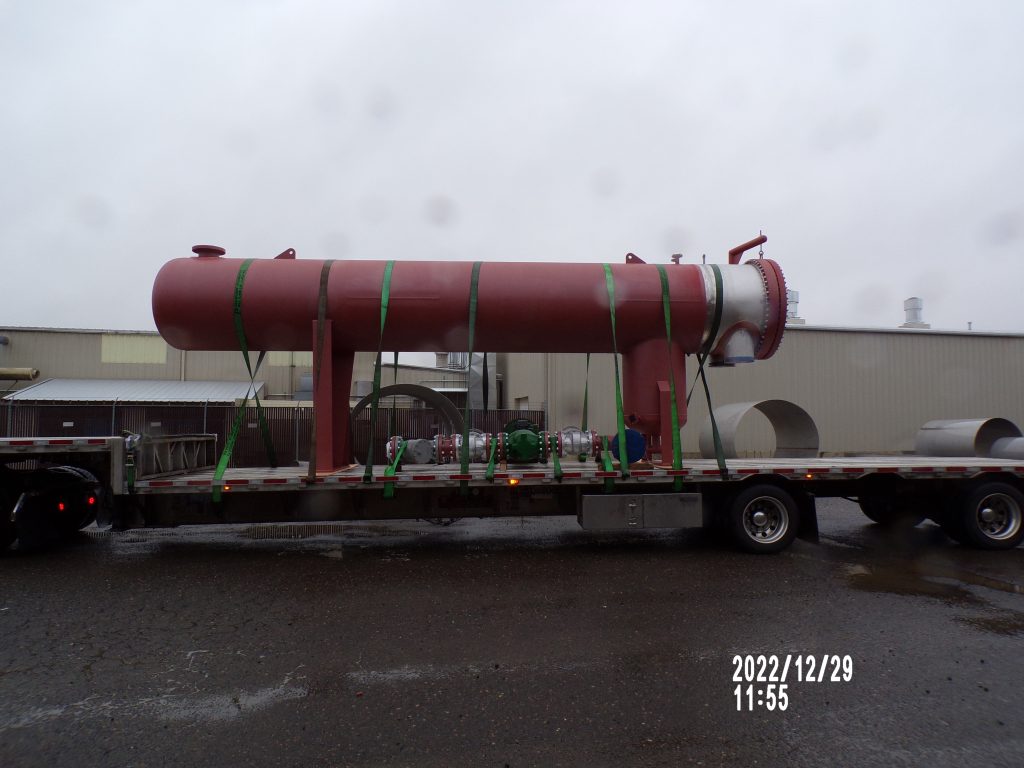
Harris Thermal has extensive experience designing and fabricating custom fry oil heat exchangers for large-scale potato and fried-food processing applications.
Oil degrades with time at temperature, so the useful design target is not just the duty — it is delivering that duty without local overheating at the tube wall, in a unit that stays cleanable and serviceable in a plant that never stops. See our shell and tube heat exchanger fabrication.
How the same physics drives different engineering choices in food, water treatment and chemical service — and what that means for an evaporator on a food stream.
Custom fry oil heaters, blanching heat exchangers, oil cooling and filtration support equipment within our fabrication scope, falling-film evaporators, crystallizers, condensers and heat recovery equipment, ASME Section VIII vessels and tanks, steam-jacketed and mixing vessels, scrubbers, cyclones and process columns.
Fry oil heating is a thermal-control problem as much as a heat-duty problem. Oil degrades with time at temperature, so the design has to deliver the required duty without local overheating at the tube wall, while staying cleanable and serviceable in a plant that runs continuously. That pushes the design toward specific tube geometry, velocity and surface-temperature targets rather than a catalog selection. Harris Thermal has extensive experience designing and fabricating custom fry oil heat exchangers for large-scale potato and fried-food processing applications.
Yes. Replacement units are built to the geometry already in the plant, so they land on the supports, nozzle positions and piping that are there — working from existing drawings, nameplate data and field measurements, or by reverse-engineering the unit where drawings no longer exist. Where the shell is sound, re-tubing the existing unit is often the better answer, and a unit can be re-rated where the duty has moved past its original basis.
304L and 316L stainless steel cover most food-processing duty, with carbon steel on utility and structural service and duplex or high-nickel alloys where the stream, temperature or process conditions call for them. Equipment is built to ASME Section VIII, Division 1 and to TEMA requirements where the exchanger design calls for it. Material selection follows the process conditions the project specifies — Harris Thermal fabricates to that specification rather than setting it.
Yes. Falling-film evaporators for concentrating starches, sugars, juices and other liquid food streams, along with the crystallizers, condensers and heat recovery equipment that run with them, plus ASME Section VIII vessels and tanks, steam-jacketed and mixing vessels, scrubbers, cyclones and process columns. Equipment is fabricated to the process conditions, materials and code requirements the project specifies.
The fluids on both sides and the duty required, the operating temperatures and pressures, and which service the unit is in — fry oil, blanching, evaporation and heat recovery each drive different design choices. For fry oil the maximum acceptable oil-side surface temperature matters as much as the duty, because that is what governs oil degradation. For a replacement, existing drawings or nameplate data, nozzle sizes and positions, and the space and supports the unit has to fit back into are usually enough to start.
Our fry oil heaters, evaporators, exchangers, and process vessels are built to your duty. Tell us what you need.